

Executive Summary
- The Trend: 52% of financial-services firms are adopting agentic AI, moving from single chatbots to multi-agent teams executing complex workflows.
- The Problem: Orchestration manages agent handoffs and keeps tasks moving, but it does not track or prove authorization.
- The Risk: When multiple agents modify a record, native orchestration cannot prove who authorized an action under what policy, creating severe audit vulnerabilities.
- The Misconception: Native event logs record agent actions, but raw activity logs are not regulatory proof of compliance or governance.
- The Solution: Financial institutions need an execution governance layer (like NovelVox CCIP) to enforce policies, pre-log actions, and establish clear authorization chains on core systems.
Financial services have quietly crossed a line.
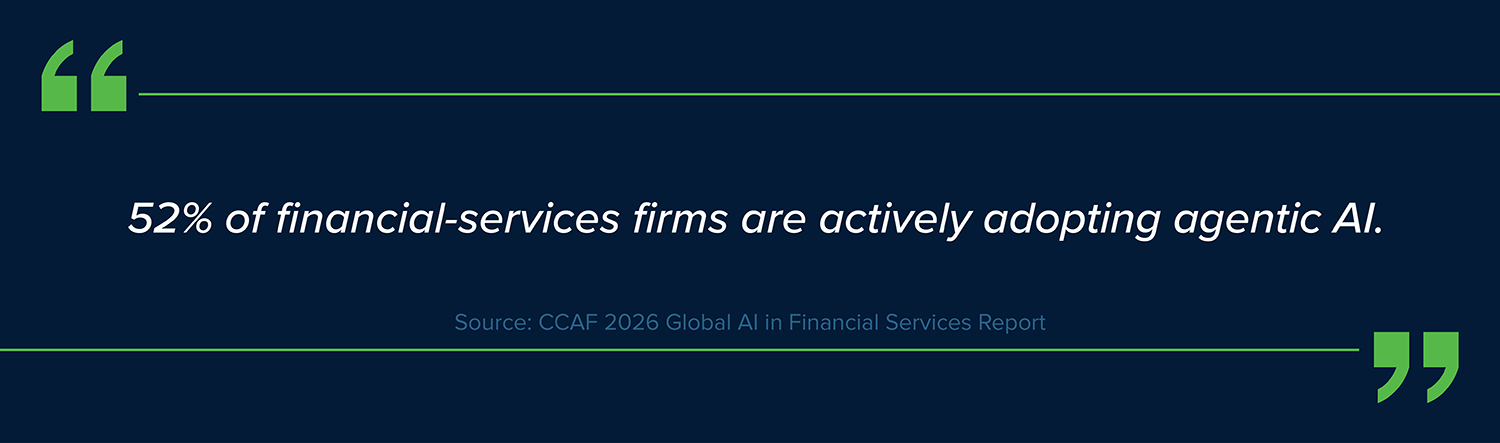
According to the CCAF 2026 Global AI in Financial Services Report, 52% of financial-services firms are already in active adoption of agentic AI, with 23% scaling or transforming and 29% piloting.
For a banking or credit union reader, the message is plain: this is not a future you get to opt into or out of. It is happening in institutions like yours right now.
Underneath that number, the shape of AI itself is changing: the industry is moving from single agents that answer one question to coordinated teams of agents that act on the same customer, the same account, and the same case.
That shift creates a distinction most vendor pitches blur. Getting agents to talk to each other is orchestration. Making sure what they do is authorized, traceable, and enforced is execution governance. These solve different problems.
Conflating the two is the costliest mistake a regulated institution can make.
That third layer proves an action was authorized, not just that it happened. That’s what we call the execution layer. Most multi-agent AI strategies never build it.
What Changed in 2026, and Why Are Banks Moving From Single Agents to Coordinated Agent Teams?
Until recently, an AI agent in a bank meant one assistant doing one job, like a chatbot answering a balance query. Multi-agent AI in banking is the next step: several specialized agents working together on a single task, each handling part of a process and handing off to the next.
One agent verifies identity, another pulls account data, another updates a record, another communicates with the customer. They coordinate, and the work moves without a human stitching each step together.
The CCAF 2026 report frames why this is arriving so fast in financial services. It found 52% of firms in active agentic-AI adoption, with fintechs already ahead of traditional institutions at 57% versus 45%.
Adoption at that level is not experimentation. It is production pressure.
McKinsey senior partners Andrea Del Miglio, Klemens Hjartar, and Saptarshi Ganguly, writing in June 2026, describe the same transition from the inside.
As Del Miglio puts it, agentic AI now means “complex multiagent systems that fully automate a process,” even though many banking leaders still use the phrase to mean simple AI-assisted tools.
That gap in language is exactly where the risk hides, because real banking work is rarely one step. A single fraud dispute touches identity, transactions, account status, and notification. A team of agents is how that kind of complexity scales.
The open question is not whether they can coordinate, but whether anyone can answer for what they did.
Key Takeaways:
- Per the CCAF 2026 report, 52% of financial-services firms are in active agentic-AI adoption. This is past experimentation.
- Multi-agent AI in banking means several specialized agents coordinating on one task, not one assistant on one question.
- The hard question the shift creates is accountability, not capability.
What Does Multi-Agent Orchestration Actually Solve?
Coordination deserves full credit, because it solves real problems.
Orchestration is what turns a pile of individual agents into a working process. It sequences the steps, routes each request to the right agent, and manages the handoffs so that the identity agent finishes before the account agent starts. Without it, you do not have a team of agents. You have a pile of tools.
Orchestration also reduces the friction that made automation brittle earlier: when a request spans four systems, it moves across all four without a human copying data between screens. That is a genuine efficiency gain.
But McKinsey is precise about how much of the value coordination represents. Saptarshi Ganguly’s estimate is direct: “the technology component, the agents, agentic layer, accounts for no more than 20 to 25 percent of the value.”
The remaining 75 to 80 percent, he says, comes from the operating model, data, talent, risk management, and governance. Orchestration lives inside that smaller slice. It makes the process run. It does not, on its own, make the process defensible.
For a deeper treatment of why coordinating systems is not the same as connecting them, our piece on orchestration versus integration covers what enterprises most often miss before a rollout.
Key Takeaways:
- Orchestration makes a group of agents behave as one process, through sequencing, routing, and handoffs, and delivers real efficiency.
- Per McKinsey, the agentic layer is only 20 to 25 percent of the value; the rest is operating model, risk, and governance.
- Coordination makes a process run. It does not make it defensible.
Where Does Orchestration Stop and Execution Governance Start?
Here is the distinction the industry keeps collapsing. It is the whole argument.
There are three layers, not two.
Integration connects systems and moves data between them.
Orchestration coordinates capabilities into a business process and manages how the steps flow.
Execution is the layer neither one touches: the proof that a given action was authorized, logged, and defensible after the fact.
Connectivity moves data. CCIP controls execution.
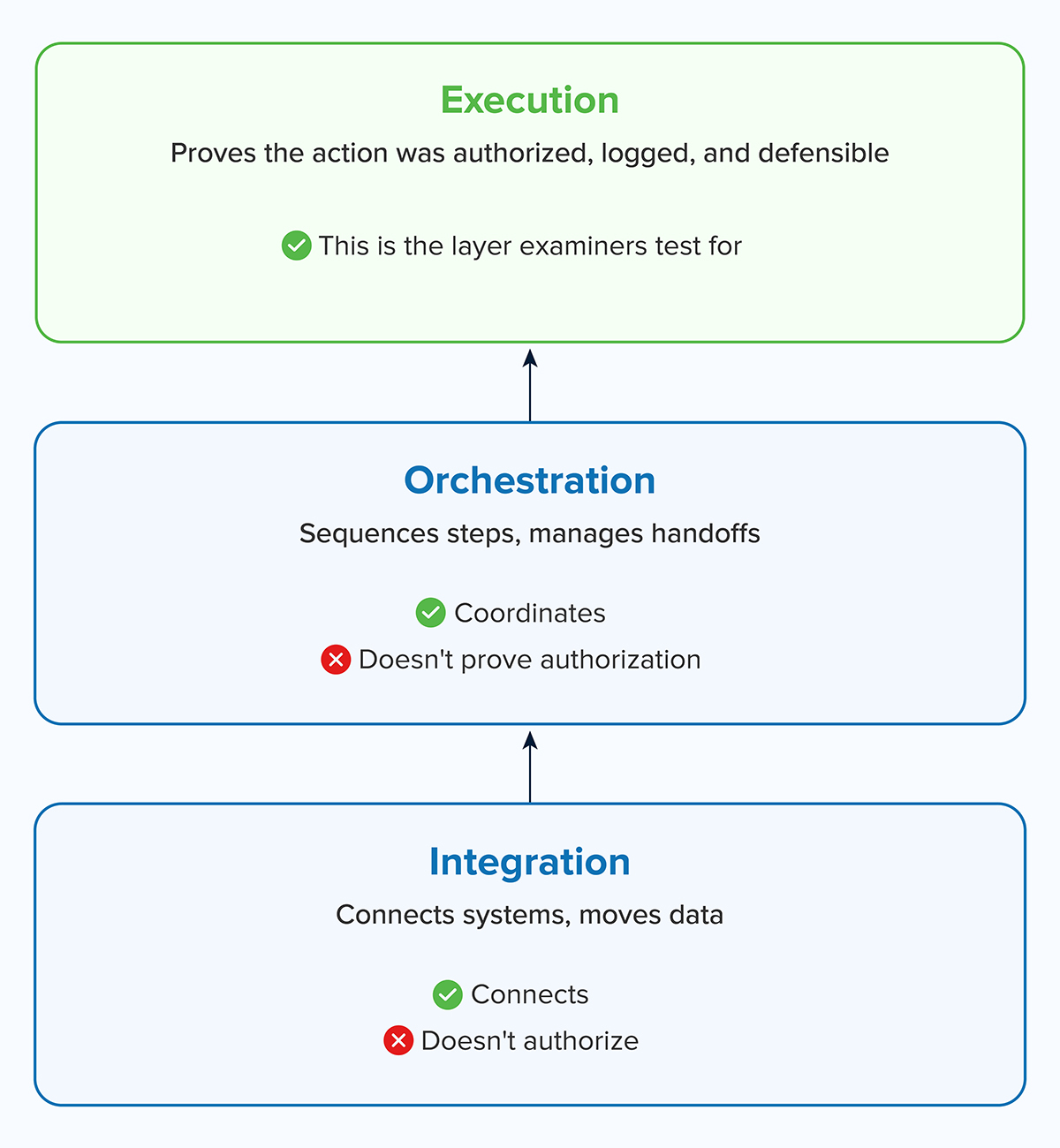
In banking and credit unions, that third layer is the one examiners actually test for.
This matters more in 2026 because agents now act with real authority. Klemens Hjartar of McKinsey describes the new pattern as “an agentic engine sitting on your desktop, with access to the same systems you have rights to use. It inherits your access rights.”
An agent that inherits a banker’s access rights can move money, change records, and close cases. Coordination decides when it acts. Nothing in coordination decides whether it should have acted, or records why it did.
McKinsey is candid that the control problem is unsolved. On agent identity and oversight, Del Miglio states plainly that “there is no market standard solution yet.” He also notes that agents “leave a full audit trail of every action they take.” But a trail of everything is not proof of the one thing an auditor asks about.
That is the execution layer: the difference between an agent that acted and an institution that can show the action was authorized under policy, logged before the fact, and enforced rather than reviewed later.
A generic orchestration platform treats that as an afterthought. In a regulated contact center, it is the part you cannot skip.
This is the framework we set out in full in Your Stack Can Talk to Everything, and Why It Still Can’t Answer to an Auditor. Multi-agent systems do not change it. They raise the stakes, because now several agents, not one, act on the same record.
Key Takeaways:
- 3 layers: integration connects systems, orchestration coordinates the process, execution proves each action was authorized and defensible.
- Agents now inherit human access rights, per McKinsey, and there is no market-standard solution yet for controlling agent identity.
- An audit trail of every action is raw material for accountability, not governance on its own
What Happens When Three AI Agents Act on One Banking Record?
Picture a single flagged transaction on one customer’s account, handled by a coordinated team of three agents. A fraud-check agent reviews the transaction and decides it is suspicious. An account-update agent places a temporary hold and adjusts the account status. A customer-communication agent notifies the customer that access has been limited and asks them to verify recent activity.
Orchestration handles this beautifully. The fraud-check agent finishes, the account-update agent acts on its conclusion, and the communication agent fires once the hold is in place. The handoffs are clean and the customer gets a timely message. This is exactly the efficiency the technology promises.
Now name the moment of ambiguity. The customer disputes the hold, or a regulator later reviews the case, and the question is simple and unforgiving: who authorized the hold?
The fraud-check agent recommended it, but recommending is not authorizing.
The account-update agent executed it, but under whose policy, and with what threshold?
The communication agent told the customer a decision had been made, but by whom?
Three agents acted on one record, and if no single authorization chain runs through all three, there is no clean answer. Each agent leaves its own trail. None of them, on its own, proves the action was permitted.
Coordination cannot see this failure mode, because its job ended when the steps got completed.
To an orchestration layer, success means the workflow ran. To a bank examiner, success means showing who approved the action, under what policy, and where the record is.
The gap between those definitions is where compliance risk accumulates quietly until something goes wrong.
We break down the warning signs of this exact condition in The Execution Layer Gap: 4 Signals Your Bank’s AI Agents Are Operating Ungoverned.
This is not hypothetical for institutions already connecting self-service to core systems.
A Leading U.S. Bank Enabled Secure, Transaction-Ready Self-Service With NovelVox CCIP
One leading U.S. bank used an execution layer to run governed, transaction-ready self-service across authentication, account servicing, loans, transfers, and payments, connecting its contact center directly to its Silver Lake core.
| Download Case Study: How a Leading U.S. Bank Enabled Secure, Transaction-Ready Self-Service With CCIP |
Key Takeaways:
- When multiple agents act on one record, recommending, executing, and communicating a decision are three separate acts by three agents.
- Coordination calls the workflow successful once the steps complete, which is not the definition an examiner uses.
- Without a single authorization chain across all agents, no one trail proves the action was authorized, and the gap stays invisible until an audit forces the question.
For CCaaS and SI Partners
The multi-agent shift is a sales opportunity and a liability at once in regulated contact centers. Ship a coordinated agent solution into a bank or credit union without a governed execution layer, and the accountability gap becomes your exposure, not just the client’s. If that client fails an audit because no one could answer who authorized an agent action, the delivery partner shares that exposure. The fix is not rebuilding your integration or orchestration stack, just adding the execution layer on top of it. That reframes governed execution from a cost the client resists into the reason they trust the deployment. It is a cleaner sell than coordination alone.
What Should You Ask a Multi-Agent AI Vendor Before You Buy?
Demos show workflows running smoothly, which is exactly why the execution layer is easy to miss. Ask these six questions before you buy:
- When several agents act on one record, which agent holds the authorization, and how is that chain recorded across all of them?
– Answers framed only around routing and handoffs describe orchestration, not execution. - Is the audit trail built to our institution’s specific policy requirements, or a generic log?
– In regulated CX it has to match what your examiners test for. Built to requirements, never a one-size-fits-all default. - Can a handoff be logged before it happens, rather than reconstructed afterward?
– Reconstruction after the fact is how institutions end up manually untangling what an agent did once something has gone wrong. - Is enforcement built into the action itself, or bolted on as a later review step?
– A policy checked after an agent has already moved money is not a control. It is a report. - When two agents reach conflicting conclusions about the same record, what governs the resolution, and is that decision itself authorized and logged?
– Multi-agent systems introduce conflicts single agents never had. - How does the vendor handle agent identity and access, given there is no market-standard solution yet?
– The honest answer shows how access and authorization are controlled and recorded in your environment.
For how governed execution runs across the core rather than around it, see Governed Agentic AI in Member Service. For the regulatory backdrop, see the EU AI Act, what changed and where the risk sits.
Key Takeaways:
- Ask who holds authorization when multiple agents act, and how that chain is recorded across all of them.
- Insist on audit trails built to your policy requirements, enforcement built into the action, and handoffs logged before they happen.
- Probe how the vendor handles conflicting agent decisions and agent identity, since neither is solved by coordination.
How Does CCIP Bring Orchestration and Execution Together for Regulated CX?
Coordination got the industry this far. The institutions that pull ahead will not be the ones running the most agents, but the ones that can prove, on demand, that every action those agents took was authorized, traced, and defensible under their own policies.
That is what an execution layer delivers, and what NovelVox built CCIP to do.
CCIP brings integration, orchestration, and execution together as one governed layer, purpose-built for banking, credit unions, and regulated CX.
It is one product with two protocols, REST and MCP, so that AI agents, IVR, and self-service can act on core systems through governed execution rather than ungoverned access.
The proof points are concrete: 17-plus years building for regulated CX, CMMi Level 3, a Jack Henry VIP Partner, and 1000+ installations , including the U.S. bank case above.
You can see where it fits in the broader stack on the NovelVox AI solutions page.
If your stack can already coordinate everything it needs to, and still cannot answer for what your agents did, that is the gap worth a conversation.